|
|
|
|
|
|
|
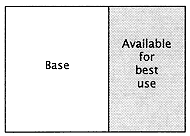
Figure 2.21
Maximizing the marginal utility of area. |
|
|
|
|
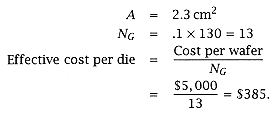
| = | 1.0 cm2, | | = | 116, | | and effective cost per die |
| = | $43 |
|
|
|
|
|
|
roughly doubling the die area may increase the die cost almost 10 times! |
|
|
|
|
|
|
|
|
Area of Processor Sub-Units |
|
|
|
|
|
|
|
|
Within a microprocessor, the amount of area a particular sub-unit of a design occupies is a primary measure of its cost. In making design choices or in evaluating the relative merits of a particular design choice, it is frequently useful to use the principle of marginal utility: assume we have a complete base design and some additional pins/area available to enhance the design. We select that design enhancement that best uses the available pins and area (Figure 2.21). Several times in this text we consider the principle of marginal utility as it applies to several design alternatives. In the absence of pinout information, we assume that area is a dominant factor in a particular tradeoff. |
|
|
|
|
|
|
|
|
In dealing with area, the obvious unit appears to be distance2either mils2 or millimeters2. However, because photolithography and geometries' resulting minimum feature sizes are constantly shifting, this is not as desirable a unit as would first appear. The need for a dimensionless distance unit was recognized early. Mead and Conway [194] proposed the unit l, the fundamental resolution, the distance by which a geometric feature on any one layer of implementation may stray from another geometric feature. |
|
|
|
|
|