|
|
|
|
|
|
|
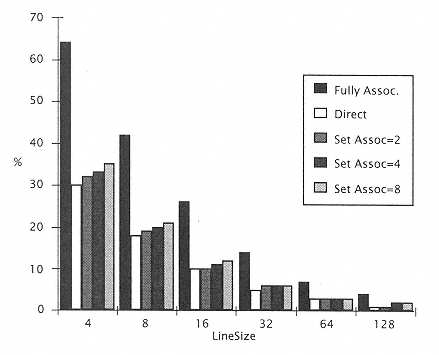
Figure 10.10
Percent total cache area used for cache tags. |
|
|
|
|
| | |
|
|
|
|
log2 (mem size/cache size) + log2 (degree of assoc.). |
|
|
|
| | | |
|
|
|
|
log2 (number of lines/degree of associativity). |
|
|
|
| | | |
|
|
|
|
log2 (number of bytes/line). |
|
|
|
|
|
|
| | |
|
|
|
|
log2 (mem size/cache size) + log2 (number of lines). |
|
|
|
| | | | | | |
|
|
|
|
log2 (number of bytes/line). |
|
|
|
|
|
|
|
|
|
|
For tag memory, four bits are added as control bits. In addition, the direct-mapped cache requires only one comparator, while the set-associative requires as many comparators as its degree of associativity. The fully associative cache requires a content-addressable memory (CAM) as its directory, since every line is a candidate. These memory bits are modeled as 2 rbe each. |
|
|
|
|
|
|
|
|
Figure 10.10 shows the tag memory area for different configurations and line sizes. The fully associative is prohibitively expensive for small line sizes, so set associativity of eight is chosen. |
|
|
|
|
|
|
|
|
Table 10.17 shows an example of the analysis carried out across different cache organizations (direct, associative, split versus unified cache) and line |
|
|
|
|
|