|
|
|
|
|
|
|
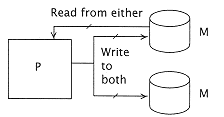
Figure 9.39
RAID1: Mirrored disk (file M is
replicated on two disks). |
|
|
|
|
|
|
|
|
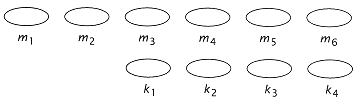
Figure 9.40
RAID2: Hamming coded file, M = m1,m2,,m6, is
distributed over multiple disks. Separate correct bits, K =
k1,,k4, are maintained one on each disk. |
|
|
|
|
|
|
|
|
Katz uses the term RAID (redundant array of inexpensive disks) to describe several techniquesin his words, "levels"for providing redundant disks to improve the integrity of data contained on a disk array. The basic approach he describes is to decompose the array into groups, with each group having an extra redundant disk containing some check information. When a disk fails, the system detects the failure, and through the use of a hot spare reconstructs the information contained on the damaged disk by using the remaining valid disks in the group together with the check disk. The reconstructed information that had been on the defective disk is written to the spare disk, which on subsequent accesses to the disk array acts in place of the defective disks. At some later time during a maintenance procedure, the faulty disk is removed and a new hot spare is placed in the array in its place. Katz et al. describe six levels of RAID and the advantages and disadvantages of each in both a transaction processing environment and a supercomputer environment. The transaction environment consists of many accesses to short files, while the supercomputer access application consists of a few accesses to very large files. |
|
|
|
|
|
|
|
|
In their terminology, RAID 1 consists of mirrored disks (Figure 9.39). In this approach, each data disk has a mirror disk simply replicating all the information on the original data disk. All writes to the data disk are also done to the redundant (mirror) disk. This approach was pioneered by Tandem Computers, which also replicated controllers and I/O buses. Mirroring doubles the cost of the storage system. It does not affect in any way the available read or write bandwidth. |
|
|
|
|
|
|
|
|
RAID 2 is a bit-interleaved array organized much as our memory was organized in chapter 6 using Hamming codes (Figure 9.40). We still must satisfy the criteria that we have a number of correct bits such that the number of correct disks k satisfies the relationship |
|
|
|
 |
|
|
|
|
2k³ k + m + 1, |
|
|
|
|
|