|
|
|
|
|
|
|
multiprogramming (n = 2 or 3), it seems prudent to assume (in the absence of other information) that all requests are made to a single disk server at any one time. Again, the square root rule can be used if the designer has some knowledge that the requests from the various processes are being effectively distributed across at least several of the disk servers. |
|
|
|
| |
|
|
|
|
The rationale for disk arrays is simple: small disk drives provide storage at the same or lower cost per megabyte than a large disk drive; yet multiple small drives have multiple access mechanisms. Hence, an ensemble of drives provides the same storage as a single large drive but with multiple access paths to information contained on these drives. The down side of multiple drives replacing a single drive is reliability. Assuming that each drive, large or small, has the same failure rate, having multiple drives will significantly increase the failure rate over one large drive. The problem, then, in the effective use of disk arrays is twofold: |
|
|
|
| |
|
|
|
|
1. Distributing data effectively across the ensemble of small drives to use the access potential afforded by the multiple drives. |
|
|
|
| |
|
|
|
|
2. Judiciously introducing redundancy into the array to restore the overall disk reliability. |
|
|
|
| |
|
|
|
|
The difficulty with achieving the preceding requirements is that the access workload to the disk array is neither uniform nor stationary. Certain access patterns may favor a particular arrangement of drives in an array, yet later when data is accessed under a different regime, still another combination of striping and synchronization may be preferable. The designer must achieve an overall balance across a relatively diverse range of workloads to achieve a robust disk array solution. |
|
|
|
|
|
|
|
|
|
9.7 Redundancy in Disk Arrays |
|
|
|
|
|
|
|
|
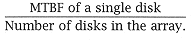
Ensembles of disks may, in particular applications, provide significant performance improvement. However, multiple drives imply multiple failure points. As pointed out by Katz et al. [158], the MTBF (mean time between failures) of a disk array is: |
|
|
|
|
|
|
|
|
This assumes that failures are independent. If a single disk has a failure rate of 30,000 hours, an array of 100 disks would have a failure rate of only 300 hours, or less than two weeks. Since the disk storage is the ultimate backing store and the only completely nonvolatile storage space in the system, its integrity is extremely important. Extra disks containing redundant information can be introduced to help preserve the integrity of the array. |
|
|
|
|
|