|
|
|
|
|
|
|
Figure 9.41
RAID3 and 4: file M = m1,mn is
distributed over n disks (bitwise in RAID3,
blockwise in RAID4). A single-parity disk
(k) maintains the message parity. |
|
|
|
|
|
|
|
|
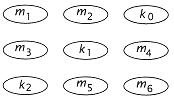
Figure 9.42
RAID5: file M = m1,
mn is distributed over n
disks in a p ´ p array when
(p - 1) ´ (p - 1) = n. Parity
is interleaved by sector
across p disks. As above,
k0 is the parity over m1
and m2, k1 is the parity for
m3 and m4, etc. |
|
|
|
|
|
|
|
|
where m is the number of data disks. If we had 10 data disks, we would need k = 4 redundant disks. |
|
|
|
|
|
|
|
|
While reducing the cost, RAID 2 has its own difficulties. It really only suits the synchronized array (ds) described earlier. The minimum file must contain 10 data blocks, since this becomes the minimum writable unit to the disk. As observed by Katz, level 2 seems to be more useful for supercomputer-type applications and in fact is used by Thinking Machines in several of their systems. |
|
|
|
|
|
|
|
|
In RAID level 3, a parity disk is introduced (Figure 9.41). This creates a type of geometric correction code discussed in Chapter 6. Data is distributed bitwise across several disks, with a final disk containing parity across the stored bit records. Failure is detected when accessing an individual disk, and the parity disk can be used to reconstruct the flawed information. Use of a parity disk requires it to be accessed on all writes, and, as with Raid 2 use, is generally suitable only for synchronized (ds) disk arrays. |
|
|
|
|
|
|
|
|
RAID 4 is not unlike RAID 3, except that rather than distributing data across disks in a bitwise fashion, each disk is allocated an entire block of the record (Figure 9.41). This improves the ability of the system to access small files (e.g., 1-block files) since only one disk plus a parity disk need be engaged in the access process. |
|
|
|
|
|
|
|
|
RAID Level 5 is shown in Figure 9.42. In RAID levels 3 and 4, all accesses require a parity disk, which becomes a bottleneck in the system. One can create a system of rotated parity across sectors where the parity information is now distributed across a series of disks on a sector-by-sector basis. This improves the number of simultaneous accesses that can be made to the disk array. |
|
|
|
|
|
|
|
|
RAID Level 6 consists of advancing RAID level 5 to two or more dimensions of parity. Imagine now that we have several dimensions of disks in which we can create both a row and a column parity. |
|
|
|
|
|