|
|
|
|
|
|
|
possible to compute thec2. For typical configurations and typical tiles, Kim [162,163] and Ogata [219] generally report the coefficient of variance to be less than .5. For the configurations cited by Reddy [244], c2 is approximately 0.15. It would seem that for initial design purposes (especially in light of the many other assumptions made in modeling these systems), the designer could reasonably assume c2 = 0.5 for large n and c2 = 1 for small n(n < 4). |
|
|
|
|
|
|
|
|
Another design issue touched on earlier is m¢, the number of independent units. For memory system design, we assume that accesses could be distributed uniformly across the low-order address bits of the memory space and hence across the interleaved memory modules. In a distributed system (q,1), blocks of a file are similarly distributed across the disks, but in other disk configurations, (1,1) for example, separate files are directed at separate disks. This situation much more closely resembles high-order interleaving than low-order interleaving in memory, and certainly calls into question the practical achievement of m¢ = l/qs. |
|
|
|
|
|
|
|
|
It is reasonable to assume that when a file is opened there are multiple accesses to the same fileor at least a relatively small number of filesrather than that subsequent accesses are made uniformly to the file servers (m¢). On the other hand, it may be somewhat severe to assume that m¢ = 1 for all cases; quite frequently, multiple files are simultaneously accessed to complete a particular transaction. A possible design position to take is that it is likely that we would achieve m¢: |
|
|
|
|
|
|
|
|
Note that this indicates an effective number of independent units m as: |
|
|
|
|
|
|
|
|
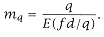
where mq represents independence based on file striping: |
|
|
|
|
|
|
|
|
Before using any such arbitrary estimate, however, the designer is cautioned to carefully consider the expected behavior of the system in light of overall system specifications. In a particular case single large files may be accessed, and it is better to assume thatm¢ = 1. Other distributional data on accessing patterns may be known that could be incorporated into the selection of the appropriate m¢. |
|
|
|
|
|
|
|
|
When the workstation-type system is being modeled with a large number of independent processors making requests on an ensemble of disk servers, it may be reasonable to simply assume that the requests are uniformly distributed across each of the servers, reducing the effect of traffic by a factor of m. However, even in this case some files (such as systems files) are accessed regularly by multiple users, and they limit the validity of the uniform distribution assumption. Depending upon the exact arrangement of the system, the designer may wish to choose an m smaller than the number of units, perhaps using the square root rule suggested before. In the case of a multiprogrammed system, especially with relatively low levels of |
|
|
|
|
|