|
|
|
|
|
|
|
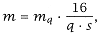
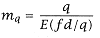
For (8,2) and (2,8) configurations, m¢ = 1. |
|
|
|
|
|
|
|
|
Study 9.5 Open-Queue Study of Various Disk Array Configurations |
|
|
|
|
|
|
|
|
We are now ready to compare the various concurrent disk configurations (and compare our results with Reddy's simulation). For this part of the study, we assume an open-queue model, and we compute the total response time based on that model. |
|
|
|
|
|
|
|
|
We use the Reddy workload defined earlier as: |
|
|
|
 |
|
|
|
|
70% 1-block file access. |
|
|
|
|
|
|
|
|
30% accesses uniformly distributed over 216-block file accesses. |
|
|
|
|
|
|
|
|
First, we need to compute the service and transfer times for each configuration. Assuming 16 disks, we have from the preceding discussion: |
|
|
|
|
|
|
|
|
In order to compute r, we must find m, the effective number of independent disk drives. Reddy's simulation assumes that the disks are uniformly accessed. Therefore: |
|
|
|
|
|
|
|
|
Now we can approximate Reddy's workload distribution overall with a co-efficient of variance of c2 = 0.15. Using tills and the previously discussed corresponding m factor for each configuration, we have: |
|
|
|
|
|