|
|
|
|
|
|
|
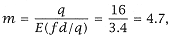
The occupancy depends on the number of independent units, m. On the average 3.4 units are occupied for each file; thus, the number of independent units m is: |
|
|
|
|
|
|
|
|
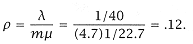
and the (best-case) occupancy is: |
|
|
|
|
|
|
|
|
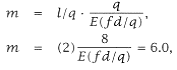
In an (8,1) system, the files longer than eight blocks must be distributed over the same eight drives and require an additional read time. Now E(f/8) = 1.16. |
|
|
|
|
|
|
|
|
Again, the transfer of the first block is assumed to be overlapped. Since the files are the same size as before, we can reduce the transfer time by the same amount we increased the service time, or by the increase in E(f/q) Tread: |
|
|
|
|
|
|
|
|
The expected number of disks to be accessed is: |
|
|
|
|
|
|
|
|
and since there are two (8,1) clusters in a 16 drive system (again,the ''best case" assumption): |
|
|
|
|
|
|
|
|
9.5.7 Disk Arrays: Files Distributed across s Synchronized (ds) Disks |
|
|
|
|
|
|
|
|
Here, the s disks (1,s) act as a single unit and are always accessed together. The bytes of each block are distributed across all s disks. Transfer from the |
|
|
|
|
|