|
|
|
|
|
|
|
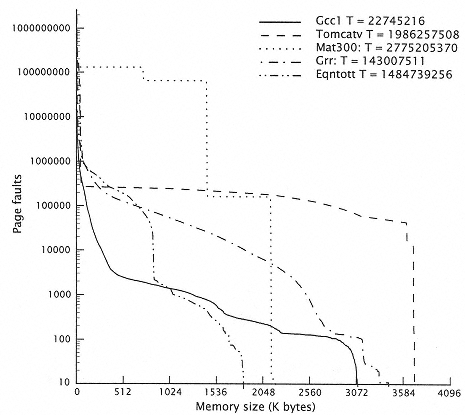
Figure 9.23
Page faults (data pages only) for various memory sizes for five benchmark
programs (from Richardson [245]). |
|
|
|
|
|
|
|
|
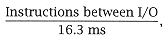
In order to get an idea of how or when these programs would be I/O limited, suppose we assume that to service these programs we have a single disk system and that a typical I/O access takes 16.3 ms (half the rotation delay for a 3600 rpm disk, 8.3 ms + 50% of 12 ms (seek) + 2 ms (transfer)). Now we can estimate when a particular program clearly becomes I/O limited as a function of CPU performance. If we take |
|
|
|
|
|
|
|
|
we get the processor performance at which half of the time is spent in processor execution and half waiting for I/O (assumes no multiprogramming). For our quite small sample of scientific programs, it is clear that while one program becomes I/O limited at processor performance of less than 25 MIPS, others are not I/O limited until beyond 100 MIPS. |
|
|
|
|
|
|
|
|
This discussion assumes that the entire program and its data requests are brought into the processor as required and that the processor memory has ample room to hold the entire application. |
|
|
|
|
|