|
|
|
|
|
|
|
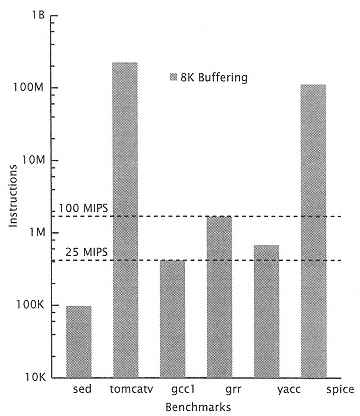
Figure 9.22
Instructions between I/O requests (from Richardson
[245], see data notes). |
|
|
|
|
|
|
|
|
Virtual memory traffic frequently dominates the I/O request rate. If the real memory is large compared to that required, only the basic I/O traffic (that defined by the program itself) is a factor as the virtual memory I/O traffic goes to zero. On the other hand, if the real memory is smaller than that required by a particular application, the virtual memory I/O traffic rate can easily overwhelm the basic I/O request rate. |
|
|
|
|
|
|
|
|
9.5.1 Basic I/O Request Rate |
|
|
|
|
|
|
|
|
Basic I/O requests represent only those accesses required to bring the static program representation into the processor for execution and subsequent data requests. This basic request rate is usually dominated by the data requests. Figure 9.22 plots the number of instructions between I/O requests assuming an 8 KB I/O buffer to prefetch requests. The six benchmarks cited represent large scientific programs and UNIX systems applications; all are run through to completion. There is an enormous variation across the programs: they vary from about 200,000 instructions between I/O requests to 700 or 800 million instructions between I/O requests. These programs are not necessarily representative of anything but perhaps the scientific environment. |
|
|
|
|
|