|
|
|
|
|
|
|
The disk has an access time (to the beginning of the requested block-seek plus rotational delay) of 17.5 ms and a read time (4KB block) of 2.5 ms. Find the effective performance and the total response time for each disk access. Assume c2 = 1. |
|
|
|
|
|
|
|
|
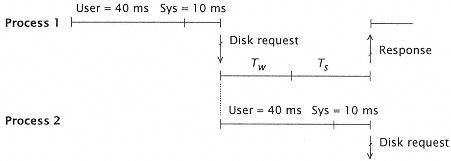
The timeline of activity is: |
|
|
|
|
|
|
|
|
We compute system performance using our finite-population closed-queue model. |
|
|
|
|
|
|
|
|
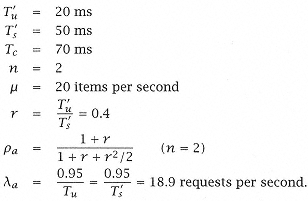
Since Tu > Ts, we have an inverted server, the processor is modeled as the server and the disk is the requestor. Now |
|
|
|
|
|
|
|
|
Note that the maximum capability of the processor is 1 request each 50 ms (20 items per second). We achieve 95% of this capacity. |
|
|
|
|
|
|
|
|
Now assume that the processor in (a) is replaced by a 40-MIPS processor (i.e., four times faster); all other parameters remain the same. What is the |
|
|
|
|
|