|
|
|
|
|
|
|
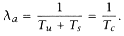
The factor f is the offered occupancy per requestor (n = 1), the ratio of the offered request rate (l = 1/Tc) to the service rate (m = 1/Ts). These factors are obviously related: |
|
|
|
|
|
|
|
|
The actual or achieved closed-loop request rate (laa) can also be written as: |
|
|
|
|
|
|
|
|
where po is the probability that the system (server) is idle. |
|
|
|
|
|
|
|
|
In a system with one requestor that waits until service before issuing another request, we have a special case. Our general model fails for this case, as seen following and in the next section. |
|
|
|
|
|
|
|
|
When there is only one request (n = 1), we have (Tw = 0), as there can be no waiting time: |
|
|
|
|
|
|
|
|
Similarly, the system reaches capacity or saturation point [166] when |
|
|
|
|
|
|
|
|
Increasing n (requestors) beyond this point causes the system to linearly slow down. For each additional requestor, the waiting time increases by Ts. |
|
|
|
|
|
|
|
|
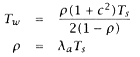
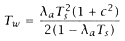
We can (computationally) determine the intermediate system behavior by recalling (M/G/1): |
|
|
|
|
|