|
|
|
|
|
|
|
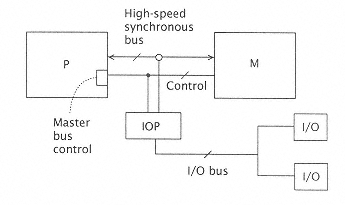
Figure 9.4
System with I/O processors. |
|
|
|
|
|
|
|
|
usually called a channel, in mainframe parlance. Using conventional microprocessor technology for I/O processors has a number of advantages, including the ability to support many of the standard asynchronous buses that allow direct connection to previously designed I/O device controllers. We have now come almost full circle, since the I/O processor may use any of the previously discussed simple I/O systems. |
|
|
|
|
|
|
|
|
Instead of using a conventional microprocessor as an I/O processor, the mainframe families use specialized I/O processors called I/O channels [45, 224]. Historically, there are several different types of channels: |
|
|
|
|
|
|
|
|
1. The multiplexor channel. This controls many slow-speed devices. It initiates multiple requests and multiplexes the data transfers from these devices a byte at a time, assembling them at the channel for proper transmission to processor memory. |
|
|
|
|
|
|
|
|
2. The selector channel. This is used for control of high-speed devices that assemble large blocks of data in the channel before transmitting the data to or from memory. |
|
|
|
|
|
|
|
|
3. The block multiplex channel. This is a more recent introduction accommodating both types of channel activity within a single I/O processor/channel. |
|
|
|
|
|
|
|
|
9.2.2 I/O System Support for Multiprocessors |
|
|
|
|
|
|
|
|
While channels and individual controllers are associated with designated processors, some I/O devices, especially elements of the disk subsystem, must be accessible not just by one processor but by any processor in a multiprocessor ensemble. Even if a particular disk drive is available, if the channel or controller for this device is occupied by a request to another drive, the drive cannot be accessed at that time. To overcome this limitation channel subsystems with multiple sub-channels can be designed which interface to multiple high-speed synchronous buses. The processor uses the channel subsystem to access an available sub-channel and path to the desired disk without interrupting any of the other processors in the system (Figure 9.5). |
|
|
|
|
|