|
|
|
|
|
|
|
Now, in comparing networks, there are two ways a network can be limited [64]: |
|
|
|
|
|
|
|
|
1. By the nodes: the number and size (lines fanout) of a node. |
|
|
|
|
|
|
|
|
2. By the links or channels (wires) connecting the nodes. |
|
|
|
|
|
|
|
|
We look at the node-limited networks in this section, and consider channel or wire limitation in the next section. |
|
|
|
|
|
|
|
|
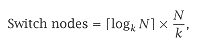
In comparing networks of comparable number and size of nodes, first compute the number of nodes in a network. For an indirect (baseline) network, we have: |
|
|
|
|
|
|
|
|
where Nis the number of compute-memory nodes to be connected and k is the number of inputs to a k ´ k crossbar switch at the switching node. For a direct (static, (k, n) cube) network, we have: |
|
|
|
 |
|
|
|
|
Switch nodes = N. |
|
|
|
|
|
|
|
|
So we can compare networks of comparable numbers of switching nodes by simply selecting a k ´ k switch that will give us a network that best approximates N. Once we have determined k for the dynamic networks, we can adjust w, the channel width, for each network to ensure that all nodes have the same number of input and output connections. |
|
|
|
|
|
|
|
|
For a static (k, n) cube, |
|
|
|
|
|
|
|
|
Fan-in plus fan-out = 2nw. |
|
|
|
|
|
|
|
|
Fan-in plus fan-out = 2kw. |
|
|
|
|
|
|
|
|
As Agarwal points out [6], there is one other important consideration in comparing networks: interconnect locality. Suppose that in a particular application only a fraction (L) of nodes communicate with each other, so that from a given processor only L (out of N) closest processors are potential destinations. In a direct static network, if we properly site nodes within their communications affinity group we can reduce the required number of hops. Now, define kdl as the expected number of hops in a (k, n) network with locality L. Then: |
|
|
|
|
|
|
|
|
This also reduces both the latency and the occupancy. |
|
|
|
|
|