|
|
|
|
|
|
|
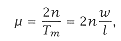
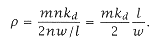
since each node has 2n channels. Tm is the time it takes a node to process a message. Then the occupancy is |
|
|
|
|
|
|
|
|
As with the dynamic case, the intermediate node cannot store a blocked message, and the queue develops at the originating node only. Which openqueue model to choose? We could use MB/D/1 as in the dynamic network; this would give |
|
|
|
|
|
|
|
|
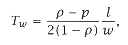
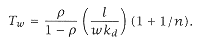
Since n = 1 is a special case, we are most interested in n ³ 2; thus, p will usually be small. Also (depending on the implementation), the service time is not necessarily constant. A blocked link may block predecessor nodes, creating a more complex service time determination. Using this rationale, for large k (k ³ 4), Agarwal [6] computes the waiting time (M/G/1) as: |
|
|
|
|
|
|
|
|
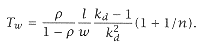
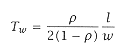
The 1/n term here is the self-contention arising when the message is directed at its own processing node. When kd is much greater than 1, the contention delay is approximately: |
|
|
|
|
|
|
|
|
Note that for a common network dimension, k = 8 (kd = k/4 = 2), Agarwal's M/G/1 gives the same result as M/D/1, ignoring the self contention factor. |
|
|
|
|
|
|
|
|
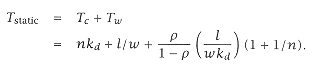
The total transit time for a message to a destination (h = 1) is |
|
|
|
|
|
|
|
|
The preceding cannot be used for low k (i.e., k = 2,3). In this case [1], we use (n large) M/D/1 and: |
|
|
|
|
|