|
|
|
|
|
|
|
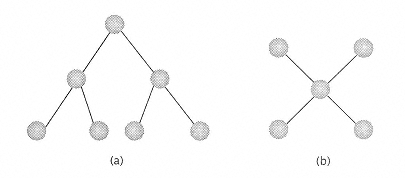
Figure 8.47
Examples of static networks with preferred sites (nodes)
. |
|
|
|
|
|
|
|
|
Simple static networks are usually direct networks, and for purposes of this discussion we assume this. We also restrict our attention to simple, cubic forms of static networks where there is no preferred communications site or node. Figure 8.47a illustrates a tree topology where the root of the tree has a preferred accessibility to the rest of the nodes. A star network (Figure 8.47b) is another example. A linear network, on the other hand (Figure 8.48a), offers some advantage to interior nodes, but by converting the linear array into a ring, one removes site preference. In general, we consider a linear array with closure (a ring) as simply an enhanced case of the linear array (Figure 8.48b). The distance between two nodes is the smallest number of links or channels (or hops) that must be traversed in establishing communications between the two nodes. The diameter of the network is the largest distance (without backtracking) between any two nodes in the network. |
|
|
|
|
|
|
|
|
Assume there are k nodes in a linear array, and we wish to interconnect several such linear arrays. Instead of simply increasing the number of linear elements, we can increase the dimensionality of the network, creating a grid network for two dimensions (Figure 8.48c). Figure 8.48(d) represents a torus, with the end-around enhancement discussed earlier, but we still refer to it as an enhanced grid or nearest-neighbor mesh. We can continue adding nodes to the network beyond the k ´ k specified in the grid by using a third dimension. Such an interconnection topology would be referred to as a k-ary three-cube [64]. When k = 2, we have the special case of the binary cube, or hypercube. In the binary hypercube, the dimensionality of the hypercube is determined by the fanout from each node. In general, the number of nodes (N) and the diameter can be determined as follows: for (2, n), the binary n-cube with bidirectional channels has: |
|
|
|
 |
|
|
|
|
N = 2n |
|
|
|
|
|
|
|
|
Diameter = n. |
|
|
|
|
|
|
|
|
For (k, n), the k-ary, n-cube with closure and bidirectional channels has |
|
|
|
|
|
|
|
|
N = kn |
|
|
|
|
|