|
|
|
|
|
|
|
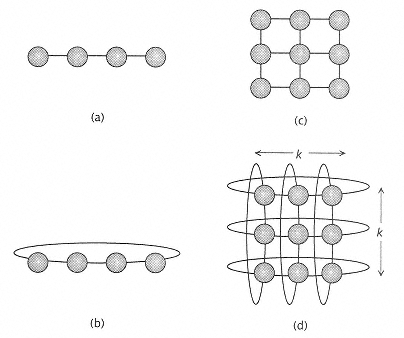
Figure 8.48
Example of static network without preferred sites. (a)
Linear array. (b) Linear array with closure (a ring). (c) Grid (
2D mesh). (d) k ´ k grid with closure (a 2D torus). These are
also called (k, d) networks. In (a) and (b), we have k = 4, d
= 1 (one-dimensional). In (c) and (d), we have k = 3, d = 2. |
|
|
|
 |
|
|
|
|
n = logk N. |
|
|
|
|
|
|
|
|
In general, it is the dimension of the network and its maximum distance that are important in cost and performance, rather than exact details of its topology. |
|
|
|
|
|
|
|
|
Links are characterized in three ways: |
|
|
|
|
|
|
|
|
1. The cycle time of the link, Tch. This corresponds to the time it requires to put a bit on a wire of a channel (or link) between neighboring nodes. 1/Tch is the bandwidth of a wire in the link or channel. |
|
|
|
|
|
|
|
|
2. The width of the channel, w. This determines the number of bits that may be concurrently transmitted between two nodes. |
|
|
|
|
|
|
|
|
3. The directionality of the channel. Channels may be unidirectional or bidirectional. It is clearly preferable for channels to be bidirectional. Nodes with communication affinity may be placed together to reduce the distance (and therefore the time) of communications. Once channel A communicates with channel B, it is usually true that B communicates with A. This establishes a locality of interconnection which, |
|
|
|
|
|