|
|
|
|
|
|
|
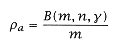
Note that g is (usually) not the physical buffer size; rather, it is the mean expected bypassed request queue per source. Finding g allows us to properly implement the physical buffer. |
|
|
|
|
|
|
|
|
and the queue per module for the |
|
|
|
|
|
|
|
|
By increasing the number of bypass registers, we realize a larger effective g. We can continue this until there is no contention, so: |
|
|
|
|
|
|
|
|
Let us call this value of g, which eliminates contention, g = gopt. We can find this by observing that "no contention" occurs when B = n, or: |
|
|
|
|
|
|
|
|
This occurs when (assuming m > n): |
|
|
|
|
|
|
|
|
Substituting Equation 7.6 into Equation 7.3 (p = 1/m), we get: |
|
|
|
|
|
|
|
|
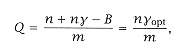
but rearranging Equation 7.4, |
|
|
|
|
|
|
|
|
since n= B at gopt. Then: |
|
|
|
 |
|
|
|
|
mQ = ngopt. |
|
|
|
|
|
|
|
|
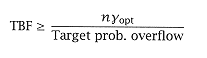
Thus, the mean total buffer size (TBF) is ngopt. |
|
|
|
|
|
|
|
|
Recall that any physical buffer that avoids overflow must be considerably larger (chapter 4), e.g.: |
|
|
|
|
|