|
|
|
|
|
|
|
or, from M/M/1 (chapter 6), |
|
|
|
|
|
|
|
|
Thus, by increasing the occupancy r and total queue size TBF, we need a physical buffer significantly larger to avoid pipeline stalls due to buffer overflow. Unless care is used in sizing the buffer, we simply exchange memory conflicts for buffer spills! Practically, it is difficult to get a good tight bound on the physical buffer. |
|
|
|
|
|
|
|
|
Assuming a reconfigurable (TBF) buffer and n < m, we suggest that, as a very rough guideline, the designer: |
|
|
|
|
|
|
|
|
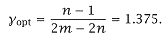
2. Set TBF= (ngopt´ 2, rounded up to the nearest power of 2. |
|
|
|
|
|
|
|
|
3. For performance evaluation purposes, assume the achieved g is g» min(gopt/2,1). |
|
|
|
|
|
|
|
|
Consider the following example. |
|
|
|
|
|
|
|
|
Assume we have a vector processor with the following parameters: |
|
|
|
 |
|
|
|
|
Processor cycle= 10 ns. |
|
|
|
|
|
|
|
|
s, the number of simultaneous memory requests per cycle = 2. |
|
|
|
|
|
|
|
|
Tc = 60 ns. |
|
|
|
|
|
|
|
|
t, cycles =per Tc = 6. |
|
|
|
|
|
|
|
|
m, modules =16. |
|
|
|
|
|
|
|
|
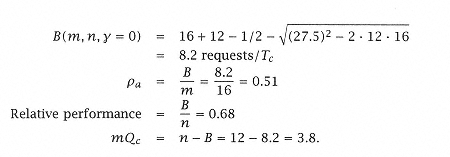
Thenm 16, n = 6 ´ 2=12. First, compute the worst-case performance, g=0: |
|
|
|
|
|
|
|
|
This requires a much larger physical buffer to avoid overflows, as the mean buffer queue is: |
|
|
|
|
|
|
|
|
mQ = ngopt= 16.5, |
|
|
|
|
|