|
|
|
|
|
|
|
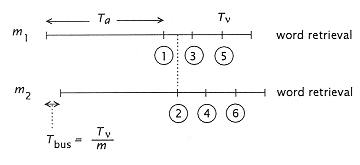
Figure 6.25
Computing line access time. |
|
|
|
|
|
|
|
|
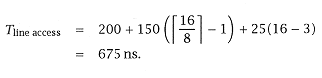
This is shown in Figure 6.25, and computed as: |
|
|
|
|
|
|
|
|
6.8.3 Contention Time (Tbusy) and Copyback Caches |
|
|
|
|
|
|
|
|
Consider a simple copyback cache (CBWA), where on a miss the processor does not resume until a dirty line (w = probability of a dirty line) is written back to memory and the new line is fully written in the cache. The miss penalty (Tmiss) or delay is: |
|
|
|
 |
|
|
|
|
Tmiss = (1 + w) Tline access. |
|
|
|
|
|
|
|
|
If we ignore the effects of I/O, however, there is no possibility of memory contention for this simple cache! The processor ceases requests to memory when memory is busy and contention cannot develop. |
|
|
|
|
|
|
|
|
Now, Tmissthe total ''effect" of a missmay be different for the cache than for the main memory. The processor may resume accessing the cache before the memory system completes processing the miss (e.g., writing back a dirty line). Let us distinguish between two miss times: |
|
|
|
|
|
|
|
|
1. Tc.missthe time the processor is idle due to a cache miss (without interference/contention). |
|
|
|
|
|
|
|
|
2. Tm.missthe total time the main memory system takes to process a miss (again ignoring contention). |
|
|
|
|
|
|
|
|
We define the potential contention time (Tbusy) as the time memory is busy and the time the processor is enabled to make requests to memory: |
|
|
|
|
|
|
|
|
Tbusy = Tm.miss - Tc.miss. |
|
|
|
|
|
|
|
|
For copy back (CBWA) caches (ignoring I/O), we might have: |
|
|
|
|
|