|
|
|
| Table 6.4 Models and their assumptions. |
| | Model | Model Assumptions | Comments | | Hellerman | No out-of-sequence requests, no queues. | Simplest type of processor. | | Strecker | No queues. | Maybe a useful model for unbuffered bus, etc. | | M/D/1 open (Flores) | Unbounded queue, Bw = lp. | Useful for initial estimates or in mixed queue models. | | MB/D/1 closed (Simple binomial) | Processor memory in stability, queue per module N = n/m. | n simple processors making n requests per Tc (n a constant). | | MB/D/1 closed (d-binomial) | Processor memory in stability, queue per module N = n/m. | n requests per Tc, each made with prob d. |
|
|
|
|
|
|
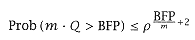
As a "rule of thumb" only, we can bound |
|
|
|
|
|
|
|
|
for m > 1. For m large, this bound may be of limited value. |
|
|
|
|
|
|
|
|
6.6.3 Comparison of Memory Models |
|
|
|
|
|
|
|
|
The issue of when to use a particular model depends a great deal on the structure of the processor and memory and the interaction between them. Each model discussed is valid for a particular type of processor-memory interaction; the question is when to use a particular model. |
|
|
|
|
|
|
|
|
Table 6.4 presents the various models with their assumptions. Hellerman's model represents the simplest type of processor. This processor does not allow out-of-sequence requests to the memory and provides no queue for addresses or requests to memory. Since the processor cannot skip over conflicting requests and has no buffer (either in memory or core processor), naturally it achieves the lowest bandwidth. Strecker's model anticipates out-of-order requests; however, it does not explicitly model queues of requests. It might indeed be applicable to multiple simple unbuffered processors. Alternatively, it can be used to model multiple processors accessing an unbuffered bus. |
|
|
|
|
|
|
|
|
The M/D/1 open model, with its assumptions of unbounded queue length and achieved bandwidth always equal to the offered bandwidth, has limited accuracy in typical processor memory situations. Still, it is useful in many situations as an initial estimate for occupancy, and can provide a reasonable estimate when the offered occupancy is low (for instance, r < 0.25). |
|
|
|
|
|