|
|
|
|
|
|
|
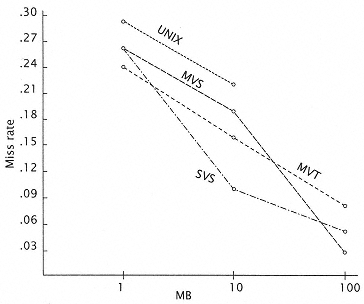
Figure 9.27
Miss rates for disk cache buffers in main memory; four
different operating environments (from Smith [261] and
Ousterhout et al. [223]). |
|
|
|
|
|
|
|
|
until that particular cache block is replaced. Note that a write-though policy would create enormous and self-defeating traffic to the disk. However, it is possible to have writes written through the processor disk cache into a special device buffer whose only function would be to preserve consistency on subsequent accessing of a particular line. |
|
|
|
|
|
|
|
|
The effectiveness of the disk cache buffers depends strongly upon the application environment and the operating system. Figure 9.27 shows three different miss ratios for two different environments using the IBM MVS, SVS, and Amdahl MVT operating systems, and then shows a UNIX operating system contrasted with the same applications running under a distributed version of UNIX called Sprite. |
|
|
|
|
|
|
|
|
Disk caches seem effective when included as part of main memory. Their overall long-term effectiveness, however, is broadly limited by the systems environment to a lower bound on the miss rate of about .03 to .30. Generally, reductions of miss rate begin to saturate at cache sizes between about 8 and 16 megabytes (Figure 9.26). |
|
|
|
|
|
|
|
|
Beyond disk cache buffers, the systems designer can use ensembles of disks to provide I/O arm and transfer bandwidth for a high-performance processor complex [215]. The disk ensembles may be used in at least three different ways: |
|
|
|
|
|
|
|
|
1. They may be used individually as an ensemble of disks, each containing multiple files, allowing the user to access the separate files |
|
|
|
|
|