|
|
|
|
|
|
|
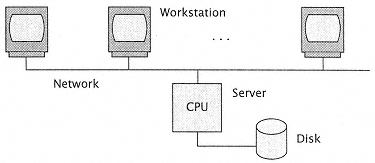
Figure 9.16
Network of diskless workstations. |
|
|
|
|
|
|
|
|
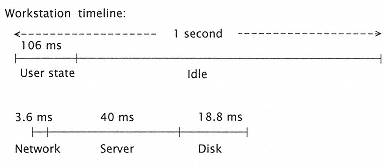
Figure 9.17
System activity per workstation request (one request per
second). |
|
|
|
|
|
|
|
|
measurements, they determined a baseline case that characterizes a network sharing a single disk in a software development environment. Each workstation processor executes in the user state 106 ms per second. This user state activity creates a service demand of a single 4-KB access to disk of 18.8 ms. Each I/O requires 40 ms of server processing and then an access to disk (Figure 9.17). The network bandwidth is significantly higher than either the disk or the server bandwidth. Since the server CPU capacity is significantly less than the disk capacity, the server CPU is the systems bottleneck. As a practical approximation, one can assume that the diskless workstation clients see only the server CPU in the system, as any queue builds in front of it and there will be little or no queueing in front of the disk. |
|
|
|
|
|
|
|
|
In order to understand the behavior of such a network one must first realize the character of the system. With a small number of workstations, the user idle time masks any server waiting time, and the system basically performs as an open queue. This situation continues until a critical number of workstations are added to the system. At that point, the system begins to saturatereach capacityand additional workstations cause the achieved utilization to be less than the offered utilization, causing significant queueing delays to be visible to the client workstations. |
|
|
|
|
|
|
|
|
We have three service centers: |
|
|
|
|
|