|
|
|
|
|
|
|
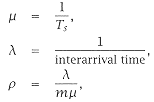
The disk latency time is the sum of the seek time and the rotational delay. For purposes of our model, we assume FIFO disk access, although other request scheduling schemes (such as shortest latency time first) can significantly reduce (perhaps by a factor of two) the apparent latency time in a system. Suppose we define Tlatency as the latency time and Tread as the time that a disk is busy moving a block of data into a buffer. If p is the number of blocks to be accessed, the disk service time Ts is equal to Tlatency + p ´ Tread. Depending on the system arrangement, an additional unoverlapped transfer time may be required to move a block from the disk to the buffer: Ttransfer = p Tread. The arrival rate (of disk requests) l and the service rate m define the occupancy r, where |
|
|
|
|
|
|
|
|
where m is the number of independent disk servers, assuming that the requests are uniformly distributed across the disks. The minimum disk response time (TR) is |
|
|
|
 |
|
|
|
|
TR = Ts + Tw, |
|
|
|
|
|
|
|
|
where Tw is the waiting time due to contention. In cases where the file is transferred to a buffer, |
|
|
|
|
|
|
|
|
TR = Ts + Ttransfer + Tw. |
|
|
|
|
|
|
|
|
Study 9.1 Processor Disk Models |
|
|
|
|
|
|
|
|
In the following study we examine some processor-disk combinations and review the suitability and limitations of our models to various system situations. |
|
|
|
|
|
|
|
|
EXAMPLE 9.1 (n = 4, m = 1) |
|
|
|
|
|
|
|
|
Assume we have four processors (n = 4), and each processor makes a disk request each 100 ms. There is one disk with Ts = 10 ms, c2 = 1. Find la, the achieved number of I/O transactions (disk accesses) per second, and the relative performance (la/l) due to disk contention. |
|
|
|
|
|
|
|
|
We can solve this problem using either of our asymptotic or low-population models. |
|
|
|
|
|