|
|
|
|
|
|
|
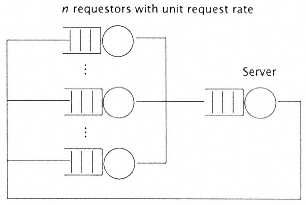
Figure 9.11
Model of multiple processors sharing a common disk server. |
|
|
|
|
|
|
|
|
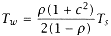
pends on both the distribution of file accesses (size of access, relative arm movement required) and the characteristics of the arm itself (as discussed earlier). For typical file and disk parameters, c2 rarely exceeds 0.5 [219]; oftentimes, it is lower. To be conservative, we suggest using c2 = 0.5 in the absence of additional information. Then |
|
|
|
|
|
|
|
|
Practical systems are a mix of open- and "closed-loop" queue models. While the I/O occupancy is low, the system behaves as an open queue. The achieved request rate is the same as the offered request rate, since the I/O waiting time does not affect overall processor performance. At some point, however, the typical system begins to experience capacity effects. Some of the tasks are slowed down because of I/O dependency. This dependency occurs for two reasons: |
|
|
|
|
|
|
|
|
1. The waiting time becomes excessive, so that by the time the processor returns to the task that made an I/O request, the information to allow that task to proceed is still not available from the I/O system. |
|
|
|
|
|
|
|
|
2. There are simply not enough tasks to mask the I/O latency, including waiting time. Adding additional independent tasks has its own costs. They occupy memory, which otherwise could be used gainfully by the current task. This is especially true in a virtual memory system, so there is a delicate balance between optimizing the virtual memory system, the paging system, and the system performance due to user file traffic. |
|
|
|
|
|
|
|
|
The simplest "mixed" I/O models are called asymptotic I/O models. They describe the system as being tolerant of delay to a point, but it then reaches capacity and slows down. To develop an asymptotic I/O model, consider an ensemble of processors requesting service from a single I/O subsystem. |
|
|
|
|
|
|
|
|
Assume we have n requestors requesting service. Once a request is made, it must be satisfied before processing proceeds (Figure 9.11). |
|
|
|
|
|