|
|
 |
|
|
|
|
K. Hwang. Computer Arithmetic: Principles, Architecture, and Design. Wiley, New York, 1978. |
|
|
|
|
|
|
|
|
American National Standards Institute. An American National Standard: IEEE standard for binary floating-point arithmetic, 1988. ANSI/IEEE Standard No. 754. |
|
|
|
|
|
|
|
|
S. Waser and M. Flynn. Introduction to Arithmetic for Digital Systems Designers. Holt, Rinehart and Winston, New York, 1982. |
|
|
|
|
|
|
|
|
1. Discuss the probable advantages and disadvantages of using microprogrammed instruction decode. |
|
|
|
|
|
|
|
|
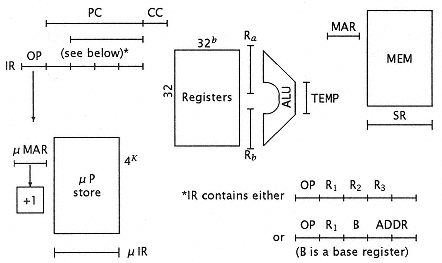
2. Consider the following simple L/S processor (see Figure 1.16). |
|
|
|
|
|
|
|
|
Its instruction layout is similar to the "generic RISC" discussed in this chapter. Its microinstruction consists of two leading bits to define the microinstruction type, and is followed by additional ICP or address information. |
|
|
|
|
|
|
|
|
For these ("00") microinstructions only the ¨MAR (microprogram address register) is incremented (+1) at the end of the execution of the microinstruction. If the leading microinstruction bits (bits 1, 2) are "00," then the remaining bits specify ICPs that indicate the following functions: |
|
|
|
|
| | | | | | | |
|
|
|
|
and gate Rb® ALU |
|
|
|
|
|
|
|
|
and gate ALU ® TEMP |
|
|
|
|
|
|
|