|
|
|
|
|
|
|
This assumes that n0¹ 0 and hence C1 actually enters and leaves the server. If n0 = 0 then |
|
|
|
|
|
|
|
|
as no item entered or left the server. We combine these as |
|
|
|
|
|
|
|
|
where d0 is the probability that n0 = 0. d0 has only two values: d0 = 0 when n0¹ 0 and d0 = 1 when n0 = 1, so that n0d0 = 0 and  . . |
|
|
|
|
|
|
|
|
Now find E(d), which lies between 0 and 1: |
|
|
|
|
|
|
|
|
by the stationarity assumption. |
|
|
|
|
|
|
|
|
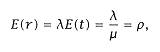
Now E(r) is the expected number of arrivals during a service time; i.e., |
|
|
|
|
|
|
|
|
The expectation that the server is idle, E(d), is |
|
|
|
|
|
|
|
|
Now suppose we generalize equation E.1 for time intervals i and i - 1 and we square both sides of equation E.1. |
|
|
|
|
|
|
|
|
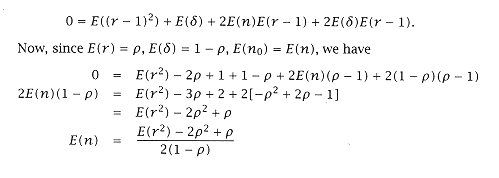
Taking the expcted value of both sides, |
|
|
|
|
|
|
|
|
again by stationary 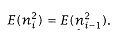 . Also, since ni-1, ri, di-1 are independent and E(ri) = E(r), etc., we have . Also, since ni-1, ri, di-1 are independent and E(ri) = E(r), etc., we have |
|
|
|
|
|