|
|
|
|
|
|
|
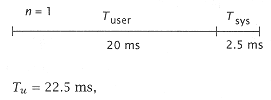
Suppose we now operated the system without multiprogramming (n = 1). This effectively allows the single process access to the whole memory and reduces the I/O request rate due to paging traffic. Suppose the effect of this additional memory is to halve the paging request rate. The user time is now 20 ms (plus 2.5 ms of system time) before I/O requests. Now |
|
|
|
|
|
|
|
|
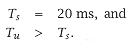
the disk service time (Ts) is |
|
|
|
|
|
|
|
|
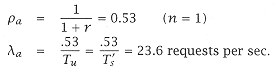
The processor is now the bottleneck and the inverted server model applies, so |
|
|
|
|
|
|
|
|
This appears to indicate that we have a significant advantage with multiprogramming, as from study 9.2(b) the achieved request rate through the system was: |
|
|
|
 |
|
|
|
|
la = 44.5 (n = 2), |
|
|
|
|
|
|
|
|
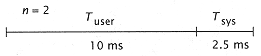
but the purpose of the system is not simply to maximize the number of I/Os per second but rather to maximize the amount of user computation per second. Now let us compute the effective amount of user computation for each case (n = 1 and n = 2). To do this and understand the dynamics of each system, consider a typical one-second time period for each case. When n = 2: |
|
|
|
|
|