|
|
|
|
|
|
|
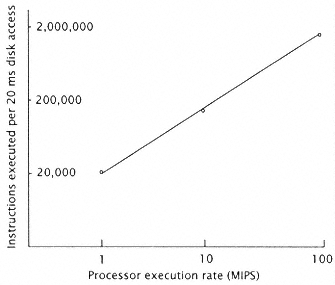
Figure 9.9
Instructions per disk access. |
|
|
|
|
|
|
|
|
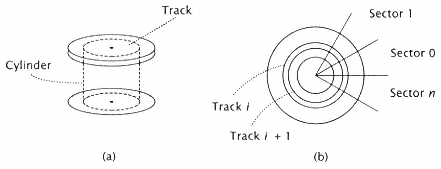
Figure 9.10
Storage tracks. |
|
|
|
|
|
|
|
|
be either read or stored with a single arm assembly movement. While each surface has its own arm, all access arms move together. Only one surface is read at a time. Seek time is the time to position the arm at a desired track (and hence at a desired cylinder). Latency time is the rotational delay for the disk to move to the correct sector within a track for a given access. Transfer time is the time required to transfer data stored (or to be stored) on a track to or from an external buffer. It does not include seek or latency time. Total disk access time is the sum of seek, latency, and transfer times. Table 9.4 lists some characteristics of typical disk drives. |
|
|
|
|
|
|
|
|
This fixed-track capacity model was widely implemented until recently. Many currently available drives now use a constant linear recording density, putting more bytes on the outer tracks than the inner tracks (capacity range about 2:1 outer to inner). This partitions the tracks into zones or unequal-size ''sectors." For purposes of our analysis, we will use the older fixed-size track model. |
|
|
|
|
|