|
|
|
|
|
|
|
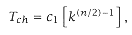
have low-dimension networks. Dally [64] proposes that the network hop time can be determined as |
|
|
|
 |
|
|
|
|
where c1 is a constant. |
|
|
|
|
|
|
|
|
Following study 8.3 (ignoring locality), compare networks (32,2) with (2,10). Develop a graph similar to Figure 8.57, now including the effect of wire on cycle time. Plot time in units of c1 against network request rate for (32,2) and (2,10). Hint: Assume low occupancy (i.e., ignore the 1 - r factor). The effect of increased network cycle time is seen by the network as an increased request rate. Ignore indirect networks. |
|
|
|
|
|
|
|
|
15. Repeat problem 14 for the conditions of study 8.4. |
|
|
|
|
|
|
|
|
16. Assume an n-processor indirect network. Using the closed-binomial model (MB/D/1), find a relationship between achieved performance (Bach) as a function of t, the hotspot traffic. (Assume 4 ´ 4 switch elements and d = r.) |
|
|
|
|
|
|
|
|
17. Assume we have 16 processor nodes in a scalable multiprocessor connected in a bidirectional ring. Nodes are labeled from 0 to 15, and a transition from a node to an adjacent node takes one network cycle (going from 0 to 1 or from 0 to 15 takes one cycle). |
|
|
|
|
|
|
|
|
Now suppose processors 1, 3, 7, and 15 are sharing a line (and have acquired it in that order) from memory resident in node 4. If processor 2 does a write to that same line, show the directories' memory state for the SCI and CD-INV protocols |
|
|
|
|
|
|
|
|
(a) Immediately before the write takes place. |
|
|
|
|
|
|
|
|
(b) After the write takes place and is acknowledged. |
|
|
|
|
|
|
|
|
18. For problem 17, using CD-INV and SCI protocols only, assume a line transmission takes 9 network cycles (latency). With wormhole routing, compute the number of network cycles. An invalidate or acknowledgement has one cycle per hop. Assume each INV and ack is a single message (no "broadcasting") |
|
|
|
|
|
|
|
|
19. Repeat problem 17 for the two update protocols (CD-UP and DD-UP). |
|
|
|
|
|
|
|
|
20. Repeat problem 18 for the two update protocols (CD-UP and DD-UP). |
|
|
|
|
|