|
|
|
|
|
|
|
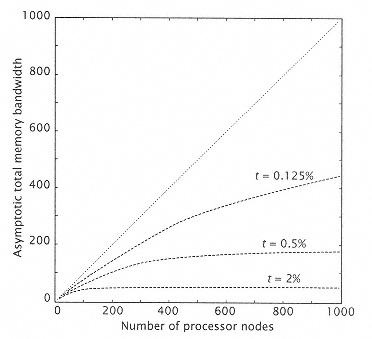
Figure8.59
Hotspot effects for various fractions of hotspot traffic
(t). |
|
|
|
|
|
|
|
|
switch cycle, and t is the fraction of references directed at the hotspot. The effective request rate to the hot memory module is: |
|
|
|
 |
|
|
|
|
Nmt + m(1 - t). |
|
|
|
|
|
|
|
|
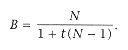
They also compute the asymptotic limit of total communication bandwidth available as a function of the number processors in the hotspot percentage: |
|
|
|
|
|
|
|
|
The maximum bandwidth is N messages per switch cycle. |
|
|
|
|
|
|
|
|
Hotspots can have quite an effect on the system, as shown in Figure 8.59. To network a thousand processors with a hotspot traffic of 0.125% limits the system to 50% efficiency. |
|
|
|
|
|
|
|
|
In order to deal with hotspots, combining networks have been proposed [110]. As messages migrate towards the hotspot, they build up traffic in the nodes in front of the hot node. Since the messages are generally performing simple commands such as test and set, fetch and add, or similar such operations, these can be combined at the intermediate node, significantly reducing traffic to the hotspot. Various types of message combining have been proposed; among the best known was the fetch and add proposal of the NYU Ultracomputer project [110]. Given that an update was called for, and the update was accomplished with a variable fetch and add, the addends could be summed in the intermediate node and the single message passed forward to the hot node for action. Returned messages |
|
|
|
|
|