|
|
|
|
|
|
|
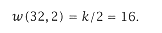
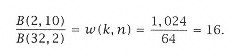
Compare the bisection width of a grid (32,2) with the hypercube (2,10). If w = 1 for the hypercube, then the link width for (32,2) for the same bisection is |
|
|
|
|
|
|
|
|
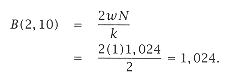
We can check this by computing B(2,10): |
|
|
|
|
|
|
|
|
Study 8.4 Networks with Constant Bisection Width |
|
|
|
|
|
|
|
|
Suppose we now consider the issue of dimensionalitywhich is better, a two dimensional 32 ´ 32 grid or a ten-dimensional binary hypercube? We can begin to get an answer to this question by arranging the two networks so that they have the same bisection width. We assume in this study, as in study 8.3, that l = 200. The bisection width of a binary 10-cube is B(2,10) = 2wN/2, where we assume w = 1. Since N = 1,024, B(2,10) = 1,024. The corresponding channel width for a 32 ´ 32 grid, w(32,2), is simply: |
|
|
|
|
|
|
|
|
The maximum bisection width is 64w, and the corresponding channel width is 1,024/64 or w(32,2) = k/2 = 16. Now the average latency (without contention) through the network is calculated as: |
|
|
|
|
|
|
|
|
For (2,10), w = 1 and kd = 0.5; while for (32,2), w = 16 and kd = 8. For the (2,10) network, this corresponds to about 205 network cycles. For the (32,2) network, we have about 28.5 cycles. Notice that the occupancy of the hypercube is the same as the occupancy of the grid. Since |
|
|
|
|
|