|
|
|
|
|
|
|
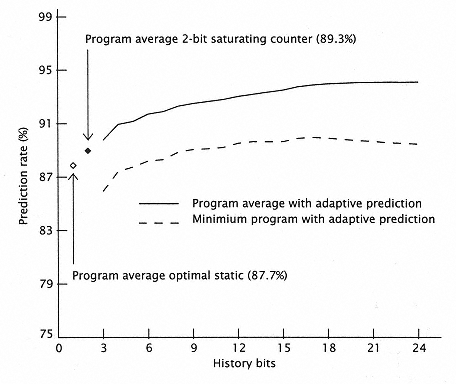
Figure 7.51
Branch prediction rates. |
|
|
|
|
|
|
|
|
significant. It is the difference between 8% misses and 14% missesalmost a 2:1 difference in overall performance. |
|
|
|
|
|
|
|
|
There is a wide body of literature spanning many approaches to multiple instruction or concurrent instruction execution and concurrent instruction issue. Results of these studies can sometimes be confusing, since the premises can be quite different. Table 7.8 illustrates some of the betterknown approaches reported in the literature, together with the reported speedup over a pipelined machine with in-order execution. The reported speedups may not be comparable, since the reference machine may be either idealized or realizable. The basic distinguishing characteristic of the studies is the scope over which the instruction dependency algorithm is applied. Studies that restrict the scope of detection to basic blockscode between branchesclearly do poorer than more complex algorithms that apply beyond basic blocks or to multiple basic blocks. |
|
|
|
|
|
|
|
|
Most studies cited issue or dispatch instructions out of order; that is, they examine N and issue M. Several of the earlier studies, however, issued only one, which of course was issued in order (N = 1, M =1). Almost all of the studies allow out-of-order execution as discussed earlier. Scheduling strategy indicates whether a dataflow or a control flow approach is used, or whether scheduling is done staticallyat compile timeand if done then, |
|
|
|
|
|