|
|
|
|
|
|
|
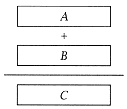
Figure 1.14
The ADD instruction.
It might seem that
there would be only
a limited number of
variations in
creating the sum of
two numbers. |
|
|
|
|
| Table 1.5 Some ADD operations in various machines. |
| | IBM S/390 | A, AR, AE, AD, AER, ADR, AP, AL, ALR | | VAX | ACBB, ACBD, ACBF, ACBG, ACBH, ACBL, ACBW, ADAWI, ADDB2, ADDB3, ADDF2, ADDF3, ADDG2, ADDG3, ADDH2, ADDH3, ADDL2, ADDL3, ADDP4, ADDP6, ADDW2, ADDW3, ADDWC, AOBLEQ, AOBLSS. | | MIPS R2000 | ADD, ADDI, ADDIU, ADDU |  |
|
|
|
|
R2010* |
|
|
|
| ADD.S, ADD.D | | *The R2010 is the floating-point coprocessor for the R2000. |
|
|
| Table 1.6 A list of the principal ADD instructions in S/390 (R/M). | | R+M data type designators | | Add (32b integers (RM: Memory to Register) | | Add (32b integers (RR: Register to Register) | | Add Floating Point32b (RM) | | Add Floating Point64b (RM) | | AE (RR) | | AD (RR) | | Add decimal, packed | | Add "logical"32b unsigned integers (RM) | | AL (RR) |
|
|
|